AI visibility
Questions, sources and market
The three AI visibility tabs behind the overview, from every question and answer to the pages assistants trusted and the modelled view of the wider market.
The Overview is the summary. These three tabs are the evidence behind it: every question and what each assistant said, the pages the answers were built from, and a modelled view of the wider market that is deliberately kept apart from your own numbers.
Questions
The questions you win and lose. Every question on the panel, what each assistant said, and the move each loss points at.
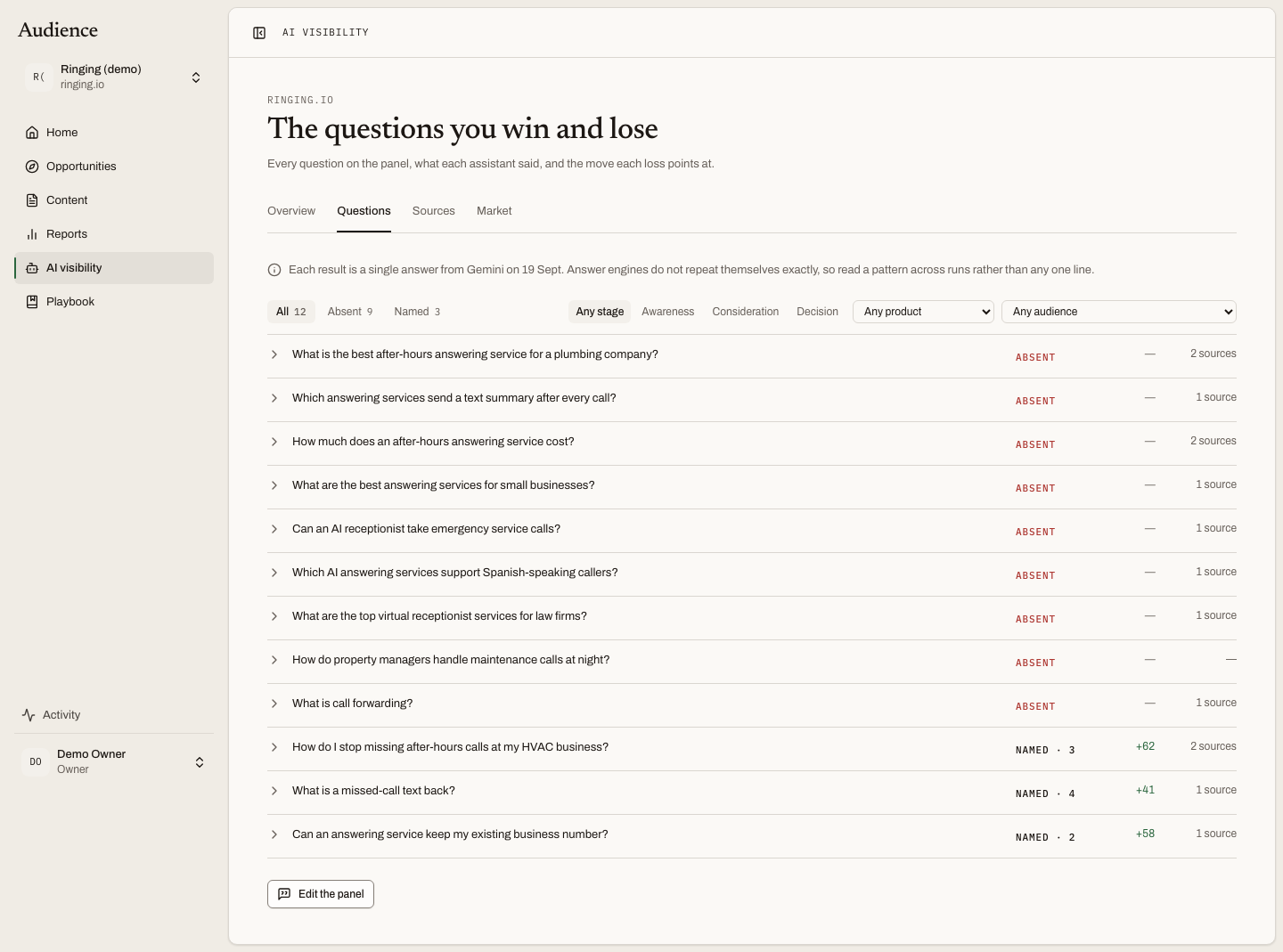 A row is one line until you open it. Then it shows the whole answer.
Above the list, a standing caveat says that each result is a single answer from one assistant on one day, and that answer engines do not repeat themselves exactly. Read a pattern across runs rather than any one line.
Lanes. Three filters with counts: All, Absent (answered without you) and Named. Where Scout tagged the questions when it suggested them, more filters appear: the journey stage (Any stage, awareness, consideration, decision), the product the question is about, and the audience asking it.
A row, opened. Collapsed, a question is one line with its status. Expanded, it shows the tone, Named instead (who came up in your place), Built from (the pages the assistant retrieved), Cited (the domains), Sample (how many runs it has been through) and the answer itself as plain prose.
Next steps. In the Absent lane, a bar above the list reads: "Each of these is a question a buyer asked and an assistant answered without you. Scout can research n as topics and carry the ones you approve to a draft." Research these n sends up to 25 at once. Each row also carries its own next step, one of three: the research action; Next step: Sent to research with the date, offered only once because a second send is a second bill; or a link to the opportunity the research produced.
Before there is a panel. With no panel confirmed, the tab says No prompt panel yet. and explains what a panel is, with a Build your panel button. With a panel confirmed but never run, it says Scout is tracking your questions and asks them every morning, that the first answers land tomorrow, and offers Run the panel now and Edit the panel.
Sources
What the answers were built from. Who the assistants named instead of you, and the pages they trusted to answer.
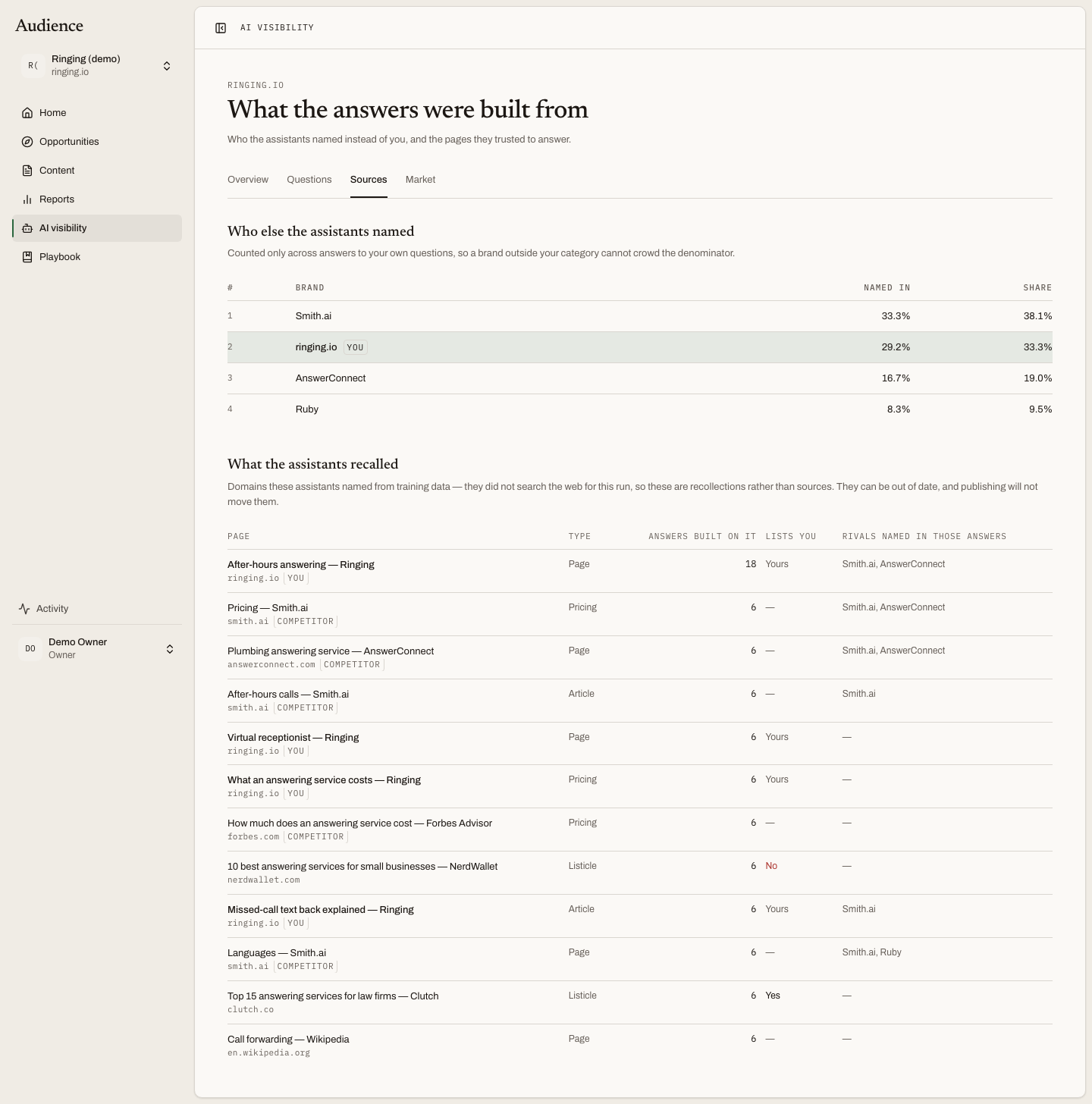 Being named is worth less than being the page the answer came from.
Who else the assistants named. The other companies that appeared in answers to your questions, counted only across your own panel so a brand outside your category cannot crowd the denominator.
What the answers were built on. When the assistants searched the web while answering, this lists the pages they actually retrieved. Scout reads each page once a week to see whether it lists you, and each row says so: Yours, Yes, No, or Not read yet. A page that does not list you is one to earn a place on; one that does is a placement to improve. Both are moves you will see on the Overview.
When the assistants did not search, the heading changes to What the assistants recalled and the caveat changes with it: these are domains named from training data, recollections rather than sources. They can be out of date, and publishing will not move them.
Before a run has recorded pages, the tab says Nothing to read yet.
Market
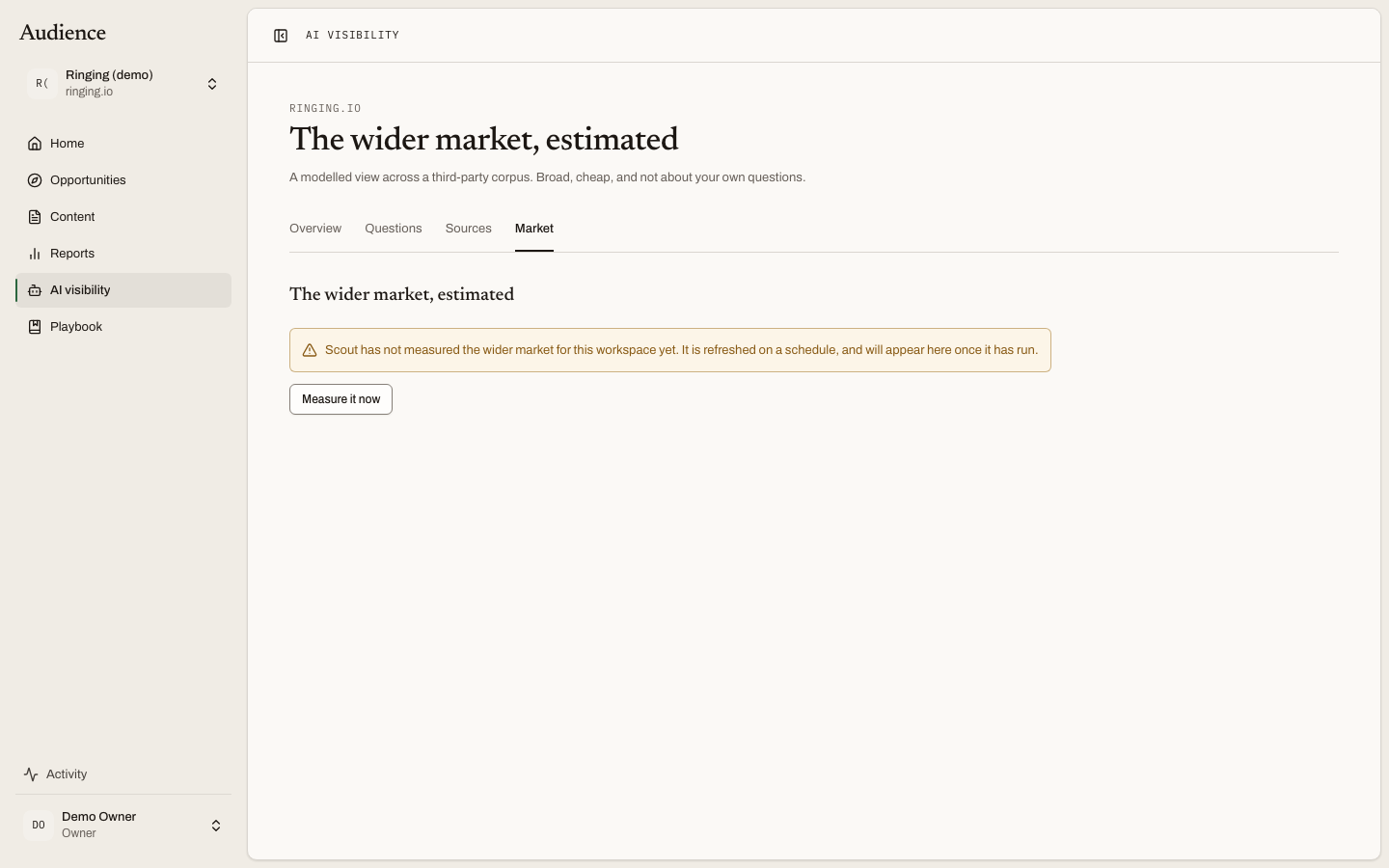
The wider market, estimated. A modelled view across a third-party corpus. Broad, cheap, and not about your own questions.
 One large brand in your confirmed competitor set can dominate this share, and the page says so.
Three numbers: Your share with your rank among the confirmed competitors, Mentions, and AI search volume (estimate). Under them, a share-of-voice leaderboard and The citation gap, which sources the engines cite for your topics and whether you are among them.
Measure it now is an explicit button because measuring the market costs money with a third party, and a page must never do that on its own. It runs in the background and the page says so, filling in when the measurement lands.
The caveats on this tab are the point of it. AI search volume is modelled, never a count of real questions. Coverage for one assistant is US and English only. The corpus is not your panel. If your workspace sits outside the covered market, a locale notice says so. If one confirmed competitor holds most of the denominator, a crowded out by warning names it and offers a one-click way to remove it from the set. And with no competitors confirmed, the tab says plainly: "Share of voice is a share of something." Confirm the competitors you actually compete with and Scout will measure your place among them.